Full Body Exercise Guide for Beginners | 6 Best Workout Routines
Full Body Exercise Guide for Beginners [6 Best Workout Routines]
If you have been putting off your fitness journey, you are not alone. Most people know they should exercise but have absolutely no idea where to begin. The gym feels intimidating. There are too many options online. And every expert seems to say something completely different.
Getting fit is actually basic. You do not need expensive equipment, a perfect body, or hours of spare time. You just need a plan that works for your level and the willingness to follow it consistently.
This guide will teach you everything you need to know, from the best full-body workout routines, aerobic exercises, and Kegel exercises to weekly workout schedules and meal plans to support your results! Upon completion, you will know exactly how to get started.
If you are also looking for healthy food ideas to pair with your new workout routine, the team at Good Food Remedies has everything you need to build healthy habits from the inside out.
Why Exercise Is the Best Habit You Will Ever Build
Most people think exercise is only about losing weight or changing how they look. But that is honestly just a small part of what regular movement does for your body and your mind.
When you exercise consistently, your energy levels go up. Your mood improves. You sleep better at night. Your heart gets stronger. You gain a quiet confidence that affects all aspects of your life, not just the gym.
Research shows that even 20 to 30 minutes of moderate exercise per day, obviously, reduces the risk of heart disease, type 2 diabetes, and depression. These are not small benefits. These are life-changing outcomes from a habit that costs you nothing but a little time and consistency.
Exercise is one of the best investments you will ever make in yourself. And the earlier you start, the more you gain in terms of improved physical health, increased energy levels, and enhanced mental well-being.
What Is a Full-Body Workout Routine, and Why Should Beginners Start Here?
A full-body workout routine means you train every major muscle group in a single session. Instead of doing leg day on Monday and chest day on Tuesday, you combine squats, push-ups, rows, and core work all in one workout.
This type of routine is recommended the most for beginners and for a good reason. When you are just starting out, your body and muscles respond best to training more. With a full-body workout, you are hitting each muscle group two to three times a week, and research shows this approach is the best way to promote muscle growth and strength.
You also only need three training days per week, which makes it much easier to stay consistent. Even if life gets busy and you miss a session, you have not missed an entire muscle group for the week. You just pick back up and keep going.
The full-body workout routine works at the gym, at home with dumbbells, or even with just your bodyweight. That flexibility is precisely why it is the perfect starting point for anyone new to fitness. For more healthy living tips that complement your training, Good Food Remedies is a wonderful place to explore.
The 6 Best Exercises Every Beginner Should Know
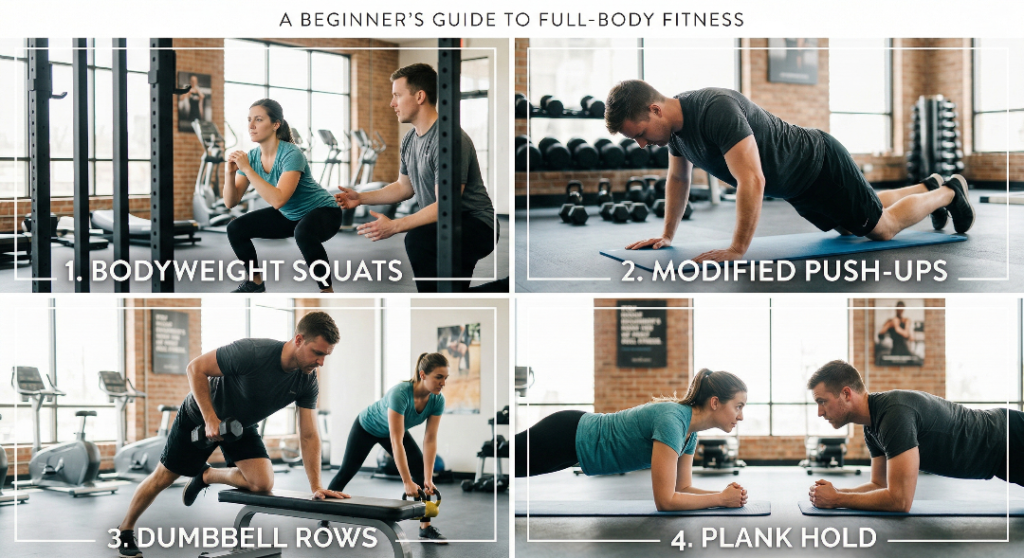
You don’t need twenty different exercises to see improvement. Doing six solid exercises consistently will cover your complete body and build the real functional strength that will carry over into your daily life activities.
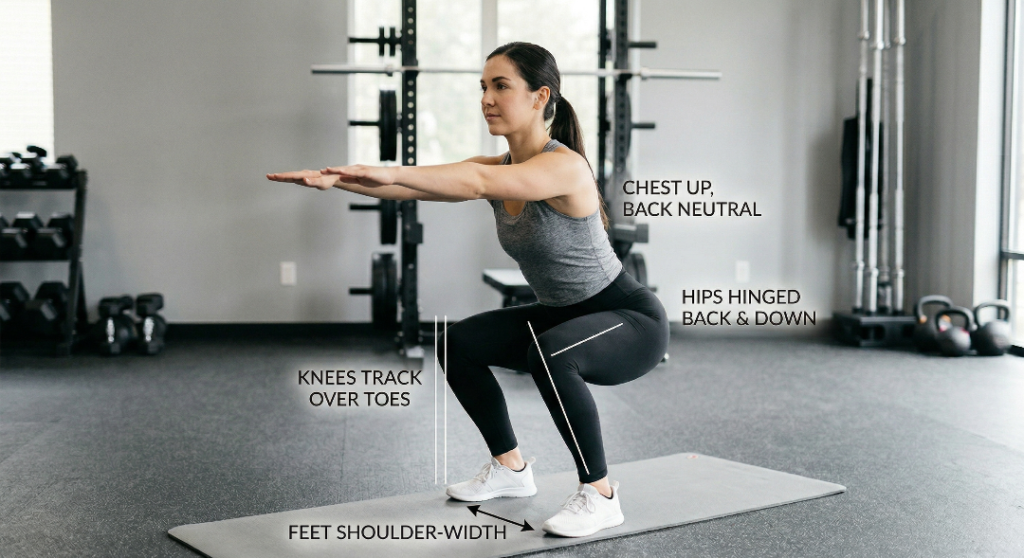
Squat
The squat is excellent for your lower body. It strengthens your quads, glutes, hamstrings, and core. First, try a bodyweight squat. Stand with your feet shoulder-width apart and lower your body as if you were sitting back in a chair, and then rise back up. Let your chest stay up and knees aligned with your toes. Do three sets of ten to fifteen reps. When that is easy, add a dumbbell and hold it at your chest.
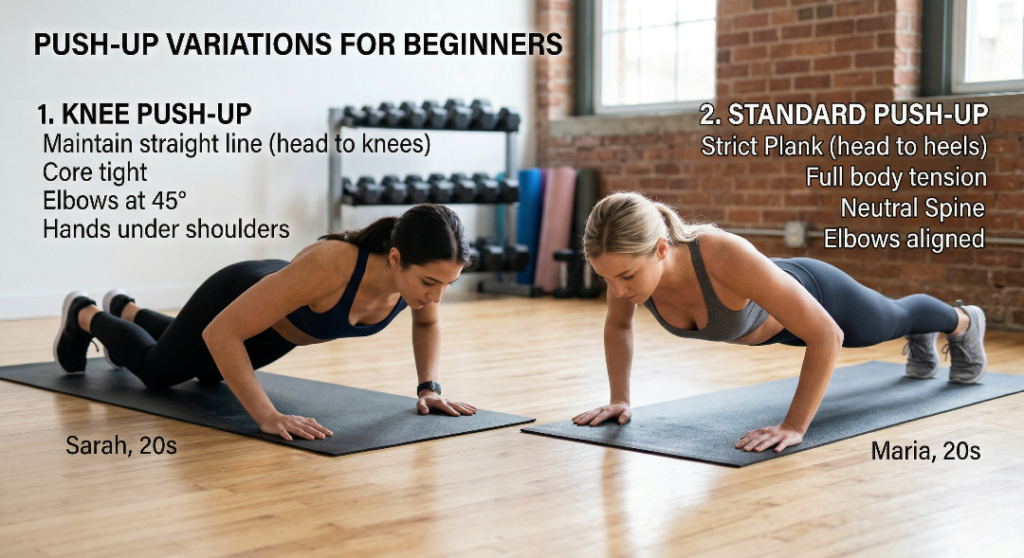
Push-Up
Push-ups build your chest, shoulders, and triceps without any equipment at all. If a full push-up is too difficult at first, start on your knees. Lower your chest toward the floor and push back up. Keep your body in a straight line. Do 3 sets of 8 to 12 reps. Most beginners who start on their knees are doing full push-ups within four to six weeks.
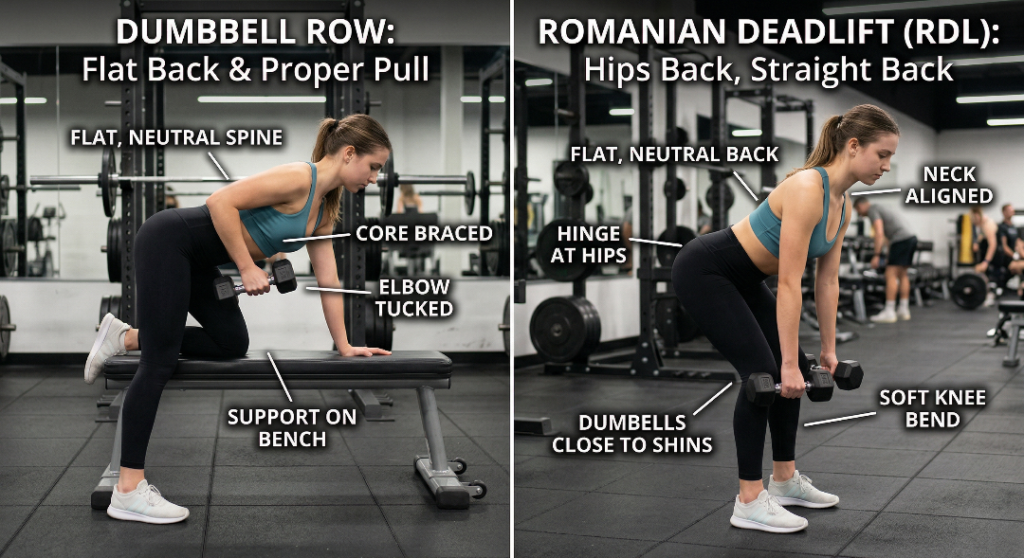
Dumbbell Row
The row trains your back muscles—an area most beginners completely neglect. Place one hand and knee on a chair for support. Hold a dumbbell in your other hand and pull it up toward your hip. Do 3 sets of 10 to 12 reps on each side. Strong back muscles improve your posture and protect your spine during every other exercise you do.
Romanian Deadlift
This workout focuses on the hamstrings, glutes, and the lower back. Hold light dumbbells in front of your thighs. Bend forward at your hips and let the weights slide down your legs until you feel a stretch in the back of your thighs. Once you feel the stretch, push your hips forward and go back to standing up. Do 3 sets of 10 to 12 reps. Start light with the weights; the movement pattern takes a few sessions to feel natural.
Overhead Press
Hold a dumbbell in each hand at shoulder height and press them overhead until your elbows are locked. Bring them down slowly. This exercise builds your shoulders and upper chest and improves your posture. Do 3 sets of 10 to 12 reps.
Plank
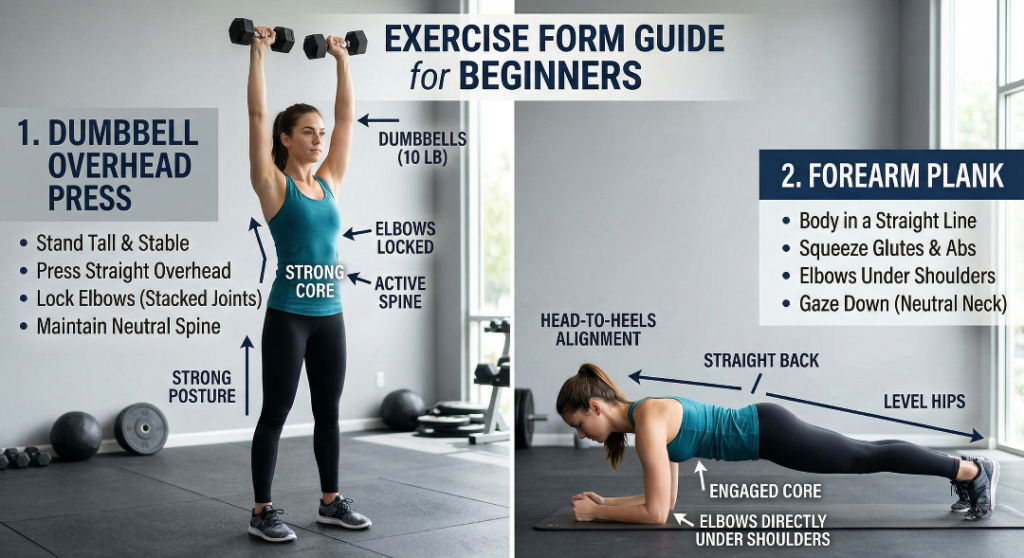
Begin into a push-up position but rest on your forearms instead of your hands. Keep your body in a straight line from head to heels. Hold for 20–40 seconds, rest, and repeat three times. The plank makes your body’s core much more stable. It develops your core and makes any other exercise more effective, while also keeping the other exercises safe.
All six exercises have one common rule to follow: outstanding technique comes before the addition of heavy weights. The goal in the first few weeks is to master each exercise’s movements, not to lift the heaviest weights. This means the addition of light weights and the development of control and a mind-muscle connection to the targeted muscles. This protects you from injury and builds a much stronger foundation for everything ahead.
Aerobic Exercise: The Part of Your Workout Routine You Cannot Skip
Many beginners focus totally on lifting weights and skip aerobic exercise completely. That is one of the biggest mistakes you can make when starting out.

Cardio, also known as aerobic exercise, is any form of exercise that increases your heart rate. It could be walking, running, cycling, swimming, or even dancing. The body uses oxygen to fuel the activity, and the benefits are entirely different from those of weight training.
Aerobic exercise has several benefits. It directly and specifically trains the heart muscle, making it stronger and more efficient. Regular aerobic exercise lowers the resting heart rate and significantly reduces the risk of heart disease.
Moderate aerobic exercise can be used to effectively burn stored body fat, especially when combined with healthy eating.
With just a few weeks of regular practice, noticeable improvements in your day-to-day activities will be clear. If you find yourself breathing heavily after walking up a few stairs or performing basic activities, your cardiovascular fitness is in need of improvement. The same is also true with just a few weeks of regular practice when you find yourself feeling more and more easily.
Generally, aerobic exercise can be one of the few habits that improves mental health. It can be effective in reducing anxiety and depression. Many people observe that a brisk daily walk or jog is one of the most effective ways of relieving stress.
For beginners, 150 minutes of moderate aerobic exercise per week is the recommended target. That is just 30 minutes, five days a week. A brisk walk absolutely counts. Start with what you can manage and build from there, gradually increasing the duration and intensity of your workouts as your fitness improves.
Along with this exercise routine, for a healthy diet and effective food remedies, be sure to visit Good Food Remedies.
Kegel Exercises: The Workout Most People Never Think About
When people discuss workout routines, kegel exercises almost never come up. But they absolutely should—and they are for both men and women, not just new mothers.
Kegel exercises work the pelvic muscles that hold the bladder, bowel, and uterus. These muscles can be affected by pregnancy, childbirth, aging, obesity, prolonged sitting, etc. Weak pelvic muscles can increase the risk of bladder incontinence, reduce sexual satisfaction, and even make some activities painful.
To find the right muscles, imagine you are trying to stop the flow of urine midstream. The pelvic floor muscles are the ones you squeeze to stop the flow of urine midstream.
Here is how to do them: compress those muscles and hold for 3 to 5 seconds, then relax completely for 3 to 5 seconds. That is one repetition. Do 10 to 15 reps in a row for one set. Aim for 3 sets per day. Make sure you are not tightening your stomach, thighs, or buttocks at the same time. The movement should be internal and isolated only to the pelvic floor.
The best thing about kegel exercises is that you can do them anywhere. You can perform them at your desk, in bed, in the car, or while standing in a queue at the grocery store. Nobody around you will ever know. Most people notice clear improvements within four to six weeks of consistent daily practice.
Your Complete Beginner Weekly Workout Schedule
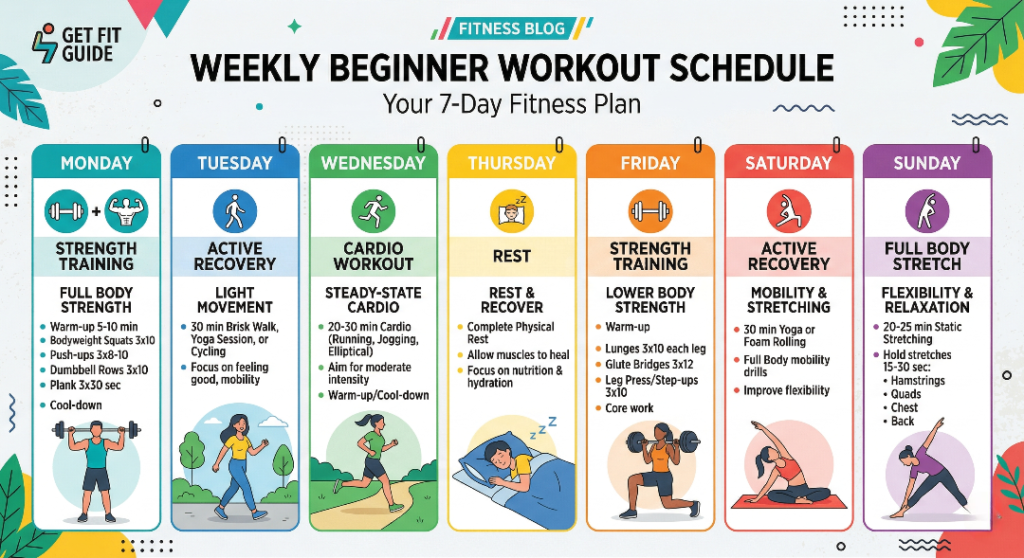
Let us now outline everything in a weekly plan starting from day one. This schedule uses three strength training days, one day of aerobic exercise, and enough rest throughout the week. It is structured to give your muscles enough stimulus to grow while also providing the necessary recovery time.
Monday — Workout A:
Squat, Push-Up, dumbbell row, and Plank (3 sets each) — 40 to 50 minutes
Tuesday — Active Recovery
A 20- to 30-minute brisk walk. Don’t forget your daily Kegel exercises! Keep it really light — you don’t want to go too hard today.
Wednesday — Workout B:
Romanian Deadlift, Overhead Press, some Plank variation, and some Core Work (3 sets each) — 40 to 50 minutes
Thursday — Rest or Light Stretching
It’s just full rest or 15 to 20 minutes of light stretching. Today your muscles are being rebuilt from their hard work, so don’t bother them.
Friday — Workout Monday Again.
You should be getting stronger if you follow the plan, so track your progress as you repeat the workouts.
Saturday — Aerobic Exercise
30 to 45 minutes of brisk walking, cycling, swimming, or light jogging. You deserve to pick the exercise you want!
Sunday — Full Rest
Complete rest; there is no need to feel guilty because this type of recovery is what your body needs the most. Your body now needs to perform the more important work, such as repairing muscles, restoring energy, and preparing you for the upcoming week.
Your first week should feel lighter than normal. Use 50 to 60 percent of the weight you think you can handle. Many beginners feel some muscle soreness after their first few sessions—especially in their legs. This is called DOMS and is completely normal. It peaks around 24 to 48 hours after a workout and disappears within one to two weeks as your body changes. Light movement helps it recover faster than staying completely still.
In addition to this exercise routine, for a healthy diet and effective food remedies, please check out Good Food Remedies.
What to Eat to Get the Most From Your Workouts

No workout is going to show the results you hope for without proper nutrition. What you eat before and after training directly affects your energy, how you perform, and how fast you recover.
Before your workout, eat a small balanced meal one to two hours before you train. Include carbohydrates for energy and some protein. A banana with peanut butter, oatmeal with berries, or yogurt with fruit all work well and are easy to put together quickly.
After your workout, eat within 30 to 60 minutes of finishing. This is when your muscles are most ready to absorb nutrients. Focus on 20 to 40 grams of protein plus some carbohydrates. Chicken with rice, eggs on toast, or a protein shake with a piece of fruit are all solid post-workout choices.
Understanding foods with the most protein will make meals for muscle building easier.
If you want a complete breakdown of the best protein sources to support your training, this high-protein foods guide covers everything in one place.
Most people do not realize that gut health plays a direct role in how well your body absorbs nutrients from food. A healthier gut means more of what you eat actually reaches your muscles. Knowing the connection between protein-rich foods and gut health can improve your recovery and your results.
Drink 2 to 3 liters of water every day and add an extra glass or two on training days. Dehydration affects your strength, your focus, and your recovery—most people are mildly dehydrated and don’t realize it.
What to Eat in the Evening After You Train
Evening training brings its own challenge. You complete a workout and feel good about it, and a few hours later, it gets close to bedtime and hunger strikes. Many beginners struggle to find the right balance and eat too much, or in some cases, do not eat at all as a strategy to control their weight after evening sessions. All these behaviors hinder your progress.
After an evening workout, your body still needs protein to repair and rebuild the muscles you worked. A light protein-rich meal or snack is the right approach. The key is choosing foods that support recovery without overloading your digestion before sleep.
If you regularly train in the evenings and want to know exactly what to reach for before bed, this guide on the best foods to eat at night for belly fat loss gives you practical options that support both your recovery and your fat loss goals at the same time.
And if late-night hunger or cravings are something you deal with often, knowing what to eat at night to lose belly fat makes a real difference to both your sleep quality and your body composition over time.
Common Mistakes That Hold Most Beginners Back
Learning from other people’s mistakes saves you months of wasted effort. These are the errors that slow down most beginners, along with specific strategies for avoiding each one.
Skipping the warm-up.
Jumping straight into exercises with cold muscles is one of the fastest ways to get injured. Spend five to ten minutes warming up with light cardio and some dynamic stretches before every session. It is not optional — it is part of the workout.
Training too much too soon.
When motivation is high in the first week, training every day feels attractive. Muscles grow during recovery, not during the workout itself. Three days per week is enough for a beginner. Stick to the plan and trust the process.
Not sleeping enough.
Real progress happens while you sleep. Your body releases the growth hormone during sleep. Sleep repairs your tissue and restores energy. If you are not sleeping seven to nine hours per night, your results will always be slower than they could be. No amount of extra training makes up for poor sleep.
Eating poorly and expecting the gym to fix it.
Exercise cannot reverse an unhealthy diet. To see real change, you need to start eating better. If you want a simple and excellent place to start eating better, the super healthy foods guide from Good Food Remedies is one of the best places to begin.
Not writing your workouts down.
Tracking your workouts is the only way to see real improvement. Write down your exercises, weights, and reps, then review them weekly to identify areas for improvement. When a weight starts feeling too easy, add a bit more. This habit will set you apart from the people who reach a plateau and quit.
Comparing yourself to others.
Everyone in the gym started exactly where you are right now. Focus only on your progress. Think about how you can be better than the you of last week, and nothing more.
Questions Beginners Ask
How long before I see results from my workout routine?
You will feel better within the first one to two weeks—more energy, improved sleep, and a better mood. Visible physical changes appear within four to eight weeks of consistent training and excellent nutrition.
Is working out three days a week really enough?
Yes—three full-body sessions per week is not just enough for beginners; it is the optimal amount. Each muscle gets trained two to three times per week, which produces better results than training each muscle once a week. After a few consistent months, you can reassess and adjust your routine if you feel ready for more.
Can I do these workouts at home without a gym?
Absolutely. You can perform push-ups, squats, planks, and Romanian deadlifts at home using only your bodyweight or a pair of light dumbbells. Many people make their best early progress training at home before ever joining a gym.
What if I feel too sore to work out?
Muscle soreness after training is natural. Walking and even bodyweight exercises can help soreness recover faster than just staying still. If it’s not severe pain or is just soreness, then training is fine. If pain is sharp or severe, then take an extra rest day and listen to what your body is telling you.
How long should each workout session take?
For beginners, 40 to 50 minutes per session is more than enough. A focused 45-minute full-body workout three times a week consistently delivers better results than long, unfocused sessions every single day.
Final Thoughts
Starting a workout routine as a beginner is simpler than most people think. You need six solid exercises, three training days per week, some aerobic exercise each week, and daily kegel exercises that take only a few minutes. Add sensible nutrition, enough water, and enough sleep—and you have absolutely everything you need to transform your fitness.
Do not overthink it. Do not wait for the perfect moment. Start this Monday with the schedule above, use lighter weights than you think you need, and focus on showing up every week. The results will always follow consistency.
The team at Good Food Remedies is always publishing new content on healthy eating, simple recipes, and practical wellness tips that make their recommendations for healthy living easy to understand and use. Bookmark this site; it is worth it.
Start today. Your future self will thank you for it.


![What to Eat at Night to Lose Belly Fat [12 Sleep-Friendly Snacks]](https://www.goodfoodremedies.com/wp-content/uploads/2026/03/12-healthy-late-night-snacks-what-to-eat-at-night-to-lose-belly-fat.jpg-768x419.png)